
The Physics of Permanence: Medical Laser Science vs. Consumer IPL

By Vladyslava Weller, Director at English Rose Beauty House
In our recent posts, we’ve talked a lot about the daily frustration of unwanted hair—the constant checking, the last-minute outfit changes, and the quiet loss of spontaneity that so many of us simply accept as normal.
When you decide you're ready to make a change, you deserve a solution that actually works—and one grounded in straightforward, unshakeable science.
But stepping into the world of hair removal can feel confusing. You are flooded with conflicting claims from high-street IPL deals, handheld home devices, and medical-grade lasers, all promising "permanent results."
As Clinic Director, my job isn't to sell you marketing buzzwords. It’s to cut through the noise, explain how the technology actually works on your skin, and give you total transparency. When you understand the basic physics behind light and human hair biology, it becomes remarkably easy to choose what’s right for you.
The Fundamental Physics: Targeted Laser Light vs. Scattered Light
To understand why results vary so dramatically between treatments, we have to look at how different light technologies behave when they touch your skin.
The main difference between a true medical-grade laser and an Intense Pulsed Light (IPL) machine comes down to focus, energy density, and precision.
1. Medical-Grade Laser (Selective Photothermolysis)
A medical laser produces a single, highly concentrated wavelength of light. Because the laser beam travels in a focused, parallel path rather than spreading out, its energy remains dense and intense as it enters the skin.
This allows us to select a precise wavelength matched specifically to melanin (the dark pigment in your hair shaft). The energy travels down the hair conduit like a targeted wire, converting to intense, localized heat right at the root.
2. IPL (Intense Pulsed Light)
IPL is not a laser. It produces broad-spectrum white light (much like the flash on a camera) containing a mixture of many different light wavelengths all at once.
Because broad-spectrum light diffuses and spreads in all directions, its energy is scattered across the skin surface and absorbed by multiple targets (including surface skin pigment and fine surface capillaries). While IPL can weaken hair temporarily, its scattered energy profile struggles to deliver the concentrated thermal dose needed deep down in the dermis to permanently disable the root.
The Biological Threshold: Coagulating vs. Stunning the Root
Why does this difference in physics matter for your long-term results? It comes down to temperature within the follicle.
To permanently reduce hair growth, light energy must heat the hair root and its active growth cells to a specific temperature threshold—typically between 65 and 70 degrees C—in a fraction of a second.
This process, called thermal coagulation, safely neutralizes the germative cells that feed the follicle, stopping it from producing a new, thick hair.
Medical Lasers deliver high peak power in precise, rapid pulses, reaching that critical 65–70 degrees target deep in the skin while keeping surrounding tissue safe.
IPL Devices spread lower power over a wide spectrum. This usually warms or "stuns" the follicle (40–50 degrees C), pushing the hair into a temporary resting phase. The hair drops out initially, but because the root cells remain alive, growth returns a few months later.
Why Dual Wavelengths Matter: The Cutera Excel HR Advantage
Human skin tones and hair depth vary greatly across different parts of the body. A single light setting or one-size-fits-all device simply cannot treat everyone safely or effectively.
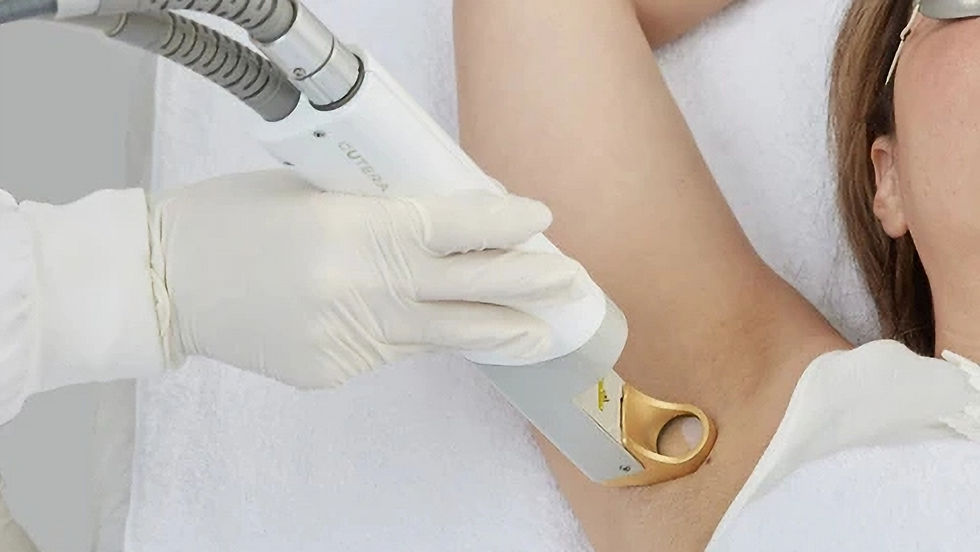
This is why we chose to invest in the gold-standard Cutera Excel HR system. It houses two distinct, medical-grade laser wavelengths:
1. The Alexandrite Wavelength (755nm)
Best For: Lighter skin tones with fine to medium hair, or stubborn remaining hairs toward the end of a treatment course.
Why It Works: It absorbs into hair pigment with exceptional strength, delivering fast, efficient results on lighter skin types.
2. The Nd:YAG Wavelength (1064nm)
Best For: Deeper or tanned skin tones, and deeply rooted, coarse hair (like the bikini line or lower face).
Why It Works: It penetrates deeper into the dermis with minimal absorption by surface skin melanin. This allows us to target deep hair roots safely without risking burns or hyperpigmentation on darker skin tones.
Protecting Your Skin: Continuous Sapphire Cooling
Delivering enough heat to disable a hair root requires real power—and real power demands top-tier cooling technology to protect your skin barrier.
Many basic machines rely on room-temperature gels or simple air blowers that warm up quickly during a session, leaving your skin feeling hot or stung.
The Cutera Excel HR features built-in Sapphire contact cooling. A chilled sapphire crystal tip sits directly against your skin, maintaining a cold, constant temperature (4 degrees C) before, during, and after every single pulse.
This continuous cooling neutralizes surface heat, protecting the epidermis and making sessions comfortable, safe, and remarkably easy to breeze through.
At-a-Glance: Medical Laser vs. IPL
Feature | High-Street / Home IPL | Cutera Excel HR Medical Laser |
Light Type | Broad-spectrum (diffused, flash-like light) | Focused, single wavelengths (755nm/1064nm) |
Action on Follicle | Warms/stuns the root temporarily | Permanently disables root cells (65-70 degrees C) |
Skin Safety | Variable; higher risk on darker or tanned skin | Dedicated 1064nm setting safe for all skin tones |
Skin Cooling | Basic air or transient gel | Continuous Sapphire chilled tip (4 degrees C) |
Long-Term Efficacy | Temporary reduction; ongoing upkeep required | Long-term permanent hair reduction |
Partnering in Your Skin Health
Choosing hair removal isn't just about picking a technology—it’s about choosing a clinic that treats you with honesty, listens to your concerns, and respects your skin.
At English Rose Beauty House, we don't believe in pushy sales or unrealistic promises. We offer proven medical technology, clear advice, and a peaceful environment where you can finally say goodbye to daily hair worries.
Whether you're starting fresh or looking for better answers after trying other methods, we are always here to help.
Ready to see what medical-grade laser can do for your skin?
Or email our team directly on salon@englishrosebeautyhouse.co.uk


Comments